
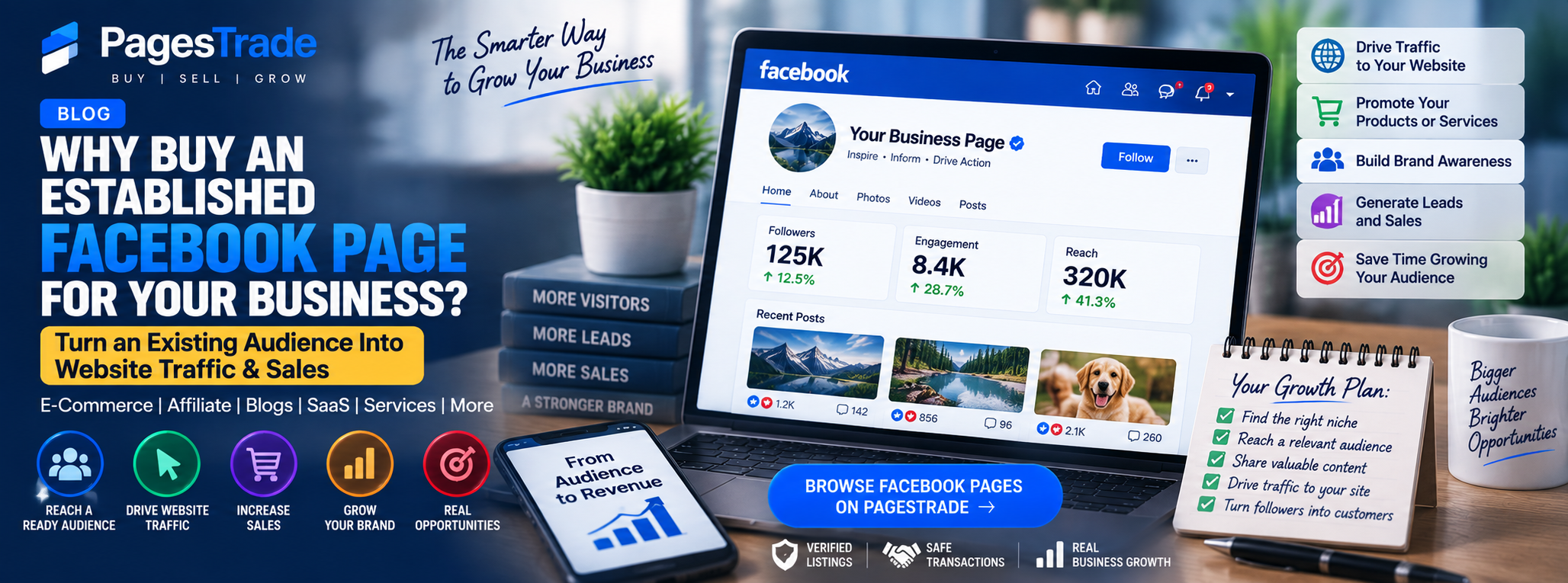
Why Buy an Established Facebook Page for Your Business? Turn an Existing Audience Into Website
Why Buy an Established Facebook Page for Your Business? Turn an Existing Audience Into Website Traffic & Sales
Starting a Facebook Page from zero can be frustrating.
You create the Page.
You upload the profile picture.
You publish your first posts.
And then you see:
0 followers.
For a business trying to promote products, generate leads or send people to a website, building an audience from scratch can take significant time.
That's one reason some entrepreneurs look at established Facebook Pages.
Instead of beginning with no audience, an established Page may already have followers, content history, engagement and a community around a particular niche.
But there's an important rule:
Don't buy the biggest audience. Look for the right audience.
A Facebook Page can have 500,000 followers and still be nearly useless for your business if those people aren't interested in what you sell.
Here's how businesses can evaluate established Facebook Pages and potentially use a relevant audience to support website traffic, product discovery, leads and sales.
Why Would a Business Want an Established Facebook Page?
Consider someone launching an online store selling camping equipment.
They could create a completely new Facebook Page and spend months building an audience.
Or they might evaluate an established Page that already publishes content about:
- Camping
- Hiking
- Outdoor adventures
- RV travel
- Fishing
- Survival equipment
If that Page has a genuine and active audience interested in those subjects, there may already be alignment between the audience and the business.
That's the opportunity.
You're not simply looking at:
100,000 followers.
You're looking at:
100,000 people who may already care about the subject your business operates in.
That distinction is critical.
Facebook Page → Content → Website → Customer
The basic strategy is straightforward:
Established Facebook Page
↓
Useful niche content
↓
Interested audience
↓
Website / Product / Landing Page
↓
Lead or Customer
Facebook shouldn't replace your website.
Instead, the two can perform different jobs.
Your Facebook presence can help with discovery, content distribution and audience relationships.
Your website can handle things such as:
- Product information
- Checkout
- Lead generation
- Email capture
- Bookings
- Detailed service information
- Blog content
- Conversion tracking
The objective is to connect the two.
Example: E-Commerce Store
Imagine you operate an online pet store.
You find an established Facebook Page about dogs with:
Followers: 120,000
But follower count alone isn't enough.
You investigate and discover:
- Audience is mostly interested in dogs
- Posts receive consistent engagement
- Videos generate healthy reach
- Audience geography matches your shipping markets
- The Page has a consistent history
- Followers appear genuine
Now the audience potentially overlaps with customers for:
- Dog beds
- Leashes
- Grooming products
- Pet accessories
- Dog food
- Training products
Instead of immediately posting:
BUY OUR DOG BED NOW! [LINK]
you could build a content strategy around useful posts.
For example:
Post 1:
5 Signs Your Dog Isn't Sleeping Comfortably
Post 2:
Video: How to Choose the Right Bed Size for Your Dog
Post 3:
Guide: Keeping Older Dogs Comfortable at Night
Then, where appropriate, direct interested users toward the relevant product or guide on your website.
That's very different from turning an established Page into a wall of advertisements.
Why Audience Relevance Matters More Than Follower Count
Suppose your business sells gym equipment.
You have two Pages to evaluate.
Page A
Followers: 500,000
Niche: Comedy memes
Page B
Followers: 80,000
Niche: Fitness and home workouts
Which is more useful?
Page A is much bigger.
But Page B's audience is much closer to people who might want:
- Dumbbells
- Resistance bands
- Workout benches
- Fitness clothing
- Training programs
- Supplements
For a business buyer, audience relevance can matter far more than raw size.
Businesses That Could Potentially Benefit
An established niche Page can support many different business models.
E-Commerce Businesses
An online store can publish useful content related to its products and direct interested visitors to product or category pages.
Examples:
Beauty Page → Cosmetics Store
Fitness Page → Gym Equipment Store
Dog Page → Pet Products
Car Page → Automotive Accessories
Cooking Page → Kitchen Products
Travel Page → Travel Gear
The closer the audience-to-product match, the more logical the strategy becomes.
Affiliate Marketers
Affiliate marketers don't necessarily sell their own products.
Instead, they recommend third-party products and may earn a commission when qualifying purchases happen through their tracking links.
Facebook can be used as part of that content funnel.
For example:
Outdoor Facebook Page
↓
Camping equipment comparison
↓
Helpful product recommendation
↓
Affiliate link or website article
↓
Merchant website
↓
Potential commission
Affiliate marketers should always follow the rules of their specific affiliate program and disclose commercial relationships appropriately.
Some programs restrict where and how affiliate links can be promoted, so never assume that every affiliate link can be used everywhere.
Bloggers and Publishers
Suppose you operate a website about home improvement.
A relevant Facebook Page could be used to distribute content such as:
- DIY tutorials
- Home renovation ideas
- Tool comparisons
- Before-and-after projects
- Interior design inspiration
- Maintenance guides
Interested readers can then visit the full article on your website.
Publishers have long used voluntarily shared Facebook links as one way of sending visitors to their own sites.
The website then controls how that traffic is monetized.
Possible monetization methods include:
- Display advertising
- Affiliate marketing
- Sponsored content
- Email subscriptions
- Products
- Services
SaaS Companies
Established audiences aren't useful only for physical products.
Imagine you've built software for small restaurants.
A Facebook Page followed by restaurant owners could potentially support:
- Educational posts
- Industry tips
- Product demonstrations
- Case studies
- Free tools
- Webinars
Those posts can direct interested businesses toward:
Your SaaS landing page → free trial → paid subscription
Again, audience fit matters.
A million entertainment followers wouldn't necessarily be more valuable than 20,000 relevant business owners.
Service Businesses
Pages can also support lead generation.
Imagine a company providing:
- Web development
- Graphic design
- Accounting
- Marketing
- Business consulting
- Real estate services
Relevant educational content can introduce the company to potential clients and direct interested users toward a:
- Contact form
- Quote request
- Consultation page
- WhatsApp conversation
- Appointment booking page
The Page acts as one part of the customer-acquisition funnel.
Why Not Just Run Facebook Ads?
You can.
Buying or acquiring an established audience isn't a replacement for paid advertising.
The strategies solve different problems.
Facebook Ads
You pay to reach targeted users.
When the campaign stops, paid distribution generally stops too.
Established Page
You have an existing audience and content presence that can potentially support ongoing organic content, community interaction and advertising strategies.
Businesses may ultimately use both.
For example:
Established Page + Organic Content + Website + Retargeting + Paid Ads
can form a broader marketing system.
An Existing Audience Can Also Help You Learn
There's another benefit businesses sometimes overlook.
An established audience gives you people to learn from.
Suppose you run a cooking Page.
You publish:
Air fryer recipe
It gets strong engagement.
Then:
BBQ recipe
Moderate engagement.
Then:
Vegan recipe
Very weak engagement.
You're learning what the audience actually wants.
Those insights can influence:
- Products
- Content
- Advertising
- Blog topics
- Email campaigns
- Offers
The Page isn't simply a traffic source.
It can also become an audience-research channel.
How to Send Facebook Visitors to Your Website
Don't turn every post into an advertisement.
A better approach is:
1. Publish Useful Native Content
Give followers a reason to keep engaging with the Page.
Examples:
- Videos
- Photos
- Tutorials
- Tips
- Comparisons
- Questions
- Stories
- Educational posts
2. Create a Relevant Website Destination
Don't always send people to your homepage.
If your Facebook post is about:
Best Hiking Shoes for Beginners
send interested users to:
yourwebsite.com/best-hiking-shoes
not simply:
yourwebsite.com
The landing page should continue the conversation started on Facebook.
3. Use Clear Calls to Action
Tell users what they'll find.
Examples:
Read the complete guide
See the full collection
Compare the products
Get a free quote
See sizes and prices
Learn more
The destination should match the promise.
Don't Spam External Links
This deserves its own section.
Buying an established Page doesn't mean you should immediately publish dozens of product links.
Facebook is primarily a content and community platform.
A better balance is:
Value → Value → Engagement → Value → Offer
rather than:
Buy → Buy → Buy → Buy → Buy
If people stop enjoying the Page, engagement can decline.
And once engagement declines, the value of the audience can decline with it.
Use the Page's Bio and Action Areas Strategically
Your Page's persistent profile elements can also direct interested visitors toward an important destination.
Depending on the Page configuration and Facebook's current features, this might be:
- Website
- Online store
- Landing page
- Booking page
- Contact destination
This is valuable because individual posts disappear down the feed over time, while important profile information remains easier for visitors to find.
Example: Affiliate Website Strategy
Suppose you own:
BestCampingGear.com
You evaluate a 150,000-follower outdoor Facebook Page.
After verifying the audience, you publish:
Monday
Short Reel:
3 mistakes first-time campers make
No hard sell.
Wednesday
Photo post:
Which tent would you choose for a rainy weekend?
Build conversation.
Friday
Useful post:
We compared 7 beginner tents — here's what we found.
Link to your detailed comparison article.
On your website, visitors can read:
- Product comparisons
- Advantages and disadvantages
- Prices
- Buying advice
and follow appropriately disclosed affiliate links.
Now Facebook isn't simply displaying links.
It's feeding an actual content funnel.
Example: Online Store Strategy
Imagine you sell kitchen equipment.
You acquire a relevant cooking Page.
Instead of posting:
BUY THIS AIR FRYER — $99
every day, create:
Monday: 30-second air fryer recipe
Tuesday: Cooking question
Wednesday: Cleaning tutorial
Thursday: Recipe image
Friday: "Our 5 favorite air fryer accessories"
Then direct interested visitors to the relevant store category.
The product becomes part of the content instead of interrupting it.
How to Choose the Right Page on PagesTrade
This is where PagesTrade can help businesses.
Don't begin by sorting only by the biggest follower count.
Start with your business.
Ask:
Who is my ideal customer?
Then look for a Page whose audience overlaps with that customer.
Step 1: Choose Your Niche
If you sell pet products, look for:
- Dogs
- Cats
- Pets
- Animal care
If you sell automotive products, consider:
- Cars
- Trucks
- Motorcycles
- Automotive enthusiasts
If you operate a travel website, consider:
- Travel
- Adventure
- Camping
- Tourism
The niche should make sense before anything else.
Step 2: Set Your Budget
PagesTrade contains opportunities across different audience sizes and price ranges.
Decide what you can realistically invest.
Don't spend your entire marketing budget simply acquiring an audience.
Remember that you may still need resources for:
- Content production
- Website improvements
- Advertising
- Email marketing
- Products
- Customer support
Treat the Page as one component of your marketing strategy.
Step 3: Compare Listings
Once you find relevant Pages, don't automatically select the biggest.
Compare:
| Metric | Why It Matters |
|---|---|
| Followers | Potential audience size |
| Niche | Business relevance |
| Engagement | Audience activity |
| Reach | Current visibility |
| Countries | Customer-market match |
| Growth | Audience health |
| History | Page consistency |
| Content | What the audience expects |
| Monetization | Additional earning potential |
| Price | Investment required |
The best Page is the one that makes the most sense for your business—not necessarily the one with the largest number.
Step 4: Perform Due Diligence
Before proceeding, verify important claims.
Ask for appropriate evidence of:
- Recent insights
- Audience geography
- Engagement
- Reach
- Follower growth
- Page history
- Monetization where claimed
- Revenue where claimed
- Relevant restrictions
PagesTrade listings can help you discover opportunities, but buyers should still evaluate whether a specific Page is suitable for their business.
Step 5: Understand Page Access
Never treat somebody's personal Facebook password as the asset.
Meta provides Page access controls that allow trusted people to manage Page content, messages, comments and other Page functions.
Any transaction should use an appropriate, documented process and comply with applicable Meta rules.
Step 6: Plan the Transition Before Changing Content
This is one of the most important steps for business buyers.
Suppose you've acquired a fitness Page.
Don't immediately delete everything and transform it into:
JOHN'S DISCOUNT SUPPLEMENT STORE!!!
Followers didn't sign up for that.
Instead, preserve the reason they followed.
Transition naturally:
Fitness content
↓
Fitness education
↓
Product-related education
↓
Relevant recommendations
↓
Business offers
The business should fit into the audience—not destroy it.
Step 7: Measure Website Traffic
Once you're publishing, measure what happens after users click.
Track:
- Link clicks
- Website sessions
- Landing-page engagement
- Email signups
- Add-to-cart events
- Leads
- Purchases
- Revenue
Tools such as Google Analytics can help you understand whether Facebook traffic actually contributes to business results.
Follower count is a vanity metric if it never produces a meaningful business outcome.
Use UTM Parameters
If you're sending traffic to your website, campaign tracking makes analysis much easier.
For example:
yourstore.com/dog-beds?utm_source=facebook&utm_medium=social&utm_campaign=dog_page
Then your analytics platform can identify traffic from that campaign.
Instead of saying:
"I think Facebook is sending customers."
you can measure it.
Calculate the Business Value
Imagine you buy a relevant established Page and over a month it generates:
5,000 website visits
From those visitors:
200 add products to cart
75 make a purchase
Average profit per order:
$25
Estimated profit:
75 × $25 = $1,875
Now you have business data you can compare with the cost of acquiring and operating the Page.
But don't assume these numbers in advance.
Every audience, business and offer performs differently.
Measure actual results.
Who Should Consider an Established Facebook Page?
This strategy can make sense for:
- E-commerce businesses
- Affiliate marketers
- Bloggers
- Publishers
- SaaS companies
- Digital product sellers
- Service businesses
- Content brands
- Online communities
- Agencies
But only when there is a logical connection between the Page audience and the business.
Who Should NOT Buy a Page?
Don't buy an established Page simply because:
"It has lots of followers."
Avoid forcing a match.
For example:
Celebrity Page → Accounting Software
Probably poor alignment.
Dog Page → Pet Store
Logical alignment.
Fitness Page → Workout App
Logical alignment.
Travel Page → Travel Booking Website
Logical alignment.
Car Page → Automotive Store
Logical alignment.
The closer the audience is to your potential customer, the stronger the strategic case.
The Biggest Mistake Business Buyers Make
The biggest mistake is thinking they're buying customers.
They're not.
They're evaluating access to an established audience and content presence.
Followers aren't guaranteed to:
- Click
- Subscribe
- Buy
- Trust a new brand
- Stay engaged after major changes
Your content, offer, audience fit, website and transition strategy determine what happens next.
Think of an established Page as an opportunity—not guaranteed revenue.
A Simple Business Buyer Formula
Before evaluating a listing, think:
Audience Relevance × Audience Quality × Engagement × Reach × Business Fit
Then consider:
Price + Content Cost + Marketing Cost + Risk
This is much more useful than:
Followers = Value
PagesTrade Business Buyer Checklist
Before considering a Page for your company:
- Does the niche match my business?
- Are the followers genuine?
- Are they in my target countries?
- Is engagement healthy?
- Is recent reach healthy?
- Is the audience still growing?
- Does the content history match my strategy?
- Can I continue creating content they enjoy?
- Can I naturally introduce my product?
- Do I have a good landing page?
- Can I track clicks and conversions?
- Have I verified important seller claims?
- Does the price make business sense?
If most of those answers aren't clear, don't let follower count make the decision for you.
The Bottom Line
An established Facebook Page can potentially become much more than a social media profile.
For the right business, it can form part of a broader system:
Content → Audience → Website → Leads → Customers
But success depends on choosing the right Page.
A business selling fitness products should look for a relevant fitness audience.
A pet store should look for pet enthusiasts.
A travel company should look for travelers.
That's why PagesTrade shouldn't be viewed simply as a place to find "big Facebook Pages."
The real opportunity is finding an established audience that makes sense for what your business is trying to achieve.
Find a Facebook Page for Your Business on PagesTrade
PagesTrade helps businesses, marketers and entrepreneurs discover established Facebook Pages across different niches, audience sizes and price ranges.
Start with your customer.
Find a relevant niche.
Compare audience quality.
Check engagement and reach.
Verify the Page.
Then decide whether the opportunity fits your marketing strategy.
Browse Facebook Pages on PagesTrade and find an established audience that aligns with your business.
Already own an established Page?
List your Facebook Page on PagesTrade and connect with buyers looking for relevant audiences and digital growth opportunities.
This article is general educational information. Results from social media marketing aren't guaranteed. Facebook features and Meta policies can change, and affiliate programs have their own rules. Buyers should independently verify Page information and applicable platform requirements before making a transaction.